Leonardo da Vinci
 La Joconde
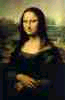
Portrait of Mona Lisa (1479-1528), also known as La Gioconda, the wife of Francesco del Giocondo; 1503-06 (150 Kb); Oil on wood, 77 x 53 cm (30 x 20 7/8 in); Musee du Louvre, Paris
This figure of a woman, dressed in the Florentine fashion of her day and seated in a visionary, mountainous landscape, is a remarkable instance of Leonardo's sfumato technique of soft, heavily shaded modeling. The Mona Lisa's enigmatic expression, which seems both alluring and aloof, has given the portrait universal fame.
Reams have been written about this small masterpiece by Leonardo, and the gentle woman who is its subject has been adapted in turn as an aesthetic, philosophical and advertising symbol, entering eventually into the irreverent parodies of the Dada and Surrealist artists. The history of the panel has been much discussed, although it remains in part uncertain. According to Vasari, the subject is a young Florentine woman, Monna (or Mona) Lisa, who in 1495 married the well-known figure, Francesco del Giocondo, and thus came to be known as ``La Gioconda''. The work should probably be dated during Leonardo's second Florentine period, that is between 1503 and 1505. Leonardo himself loved the portrait, so much so that he always carried it with him until eventually in France it was sold to François I, either by Leonardo or by Melzi.
From the beginning it was greatly admired and much copied, and it came to be considered the prototype of the Renaissance portrait. It became even more famous in 1911, when it was stolen from the Salon Carré in the Louvre, being rediscovered in a hotel in Florence two years later. It is difficult to discuss such a work briefly because of the complex stylistic motifs which are part of it. In the essay ``On the perfect beauty of a woman'', by the 16th-century writer Firenzuola, we learn that the slight opening of the lips at the corners of the mouth was considered in that period a sign of elegance. Thus Mona Lisa has that slight smile which enters into the gentle, delicate atmosphere pervading the whole painting. To achieve this effect, Leonardo uses the sfumato technique, a gradual dissolving of the forms themselves, continuous interaction between light and shade and an uncertain sense of the time of day.
There is another work of Leonardo's which is perhaps even more famous than The Last Supper. It is the portrait of a Florentine lady whose name was Lisa, Mona Lisa. A fame as great as that of Leonardo's Mona Lisa is not an unmixed blessing for a work of art. We become so used to seeing it on picture postcards, and even advertisements, that we find it difficult to see it with fresh eyes as the painting by a real man portraying a real woman of flesh and blood. But it is worth while to forget what we know, or believe we know, about the picture, and to look at it as if we were the first people ever to set eyes on it. What strikes us first is the amazing degree to which Lisa looks alive. She really seems to look at us and to have a mind of her own. Like a living being, she seems to change before our eyes and to look a little different every time we come back to her. Even in photographs of the picture we experience this strange effect, but in front of the original in the Louvre it is almost uncanny. Sometimes she seems to mock at us, and then again we seem to catch something like sadness in her smile. All this sounds rather mysterious, and so it is; that is so often the effect of a great work of art. Nevertheless, Leonardo certainly knew how he achieved this effect, and by what means. That great observer of nature knew more about the way we use our eyes than anybody who had ever lived before him. He had clearly seen a problem which the conquest of nature had posed to artists - a problem no less intricate than the one of combining correct drawing with a harmonious composition. The great works of the Italian Quattrocento masters who followed the lead given by Masaccio have one thing in common: their figures look somewhat hard and harsh, almost wooden. The strange thing is that it clearly is not lack of patience or lack of knowledge that is responsible for this effect. No one could be more patient in his imitation of nature than Van Eyck; no one could know more about correct drawing and perspective than Mantegna. And yet, for all the grandeur and impressiveness of their representations of nature, their figures look more like statues than living beings. The reason may be that the more conscientiously we copy a figure line by line and detail by detail, the less we can imagine that it ever really moved and breathed. It looks as if the painter had suddenly cast a spell over it, and forced it to stand stock-still for evermore, like the people in The Sleeping Beauty. Artists had tried various ways out of this difficulty. Botticelli, for instance, had tried to emphasize in his pictures the waving hair and the fluttering garments of his figures, to make them look less rigid in outline. But only Leonardo found the true solution to the problem. The painter must leave the beholder something to guess. If the outlines are not quite so firmly drawn, if the form is left a little vague, as though disappearing into a shadow, this impression of dryness and stiffness will be avoided. This is Leonardo's famous invention which the Italians call sfumato- the blurred outline and mellowed colors that allow one form to merge with another and always leave something to our imagination.
If we now return to the Mona Lisa, we may understand something of its mysterious effect. We see that Leonardo has used the means of his 'sfumato' with the utmost deliberation. Everyone who has ever tried to draw or scribble a face knows that what we call its expression rests mainly in two features: the corners of the mouth, and the corners of the eyes. Now it is precisely these parts which Leonardo has left deliberately indistinct, by letting them merge into a soft shadow. That is why we are never quite certain in what mood Mona Lisa is really looking at us. Her expression always seems just to elude us. It is not only vagueness, of course, which produces this effect. There is much more behind it. Leonardo has done a very daring thing, which perhaps only a painter of his consummate mastery could risk. If we look carefully at the picture, we see that the two sides do not quite match. This is most obvious in the fantastic dream landscape in the background. The horizon on the left side seems to lie much lower than the one on the right. Consequently, when we focus on the left side of the picture, the woman looks somehow taller or more erect than if we focus on the right side. And her face, too, seems to change with this change of position, because, even here, the two sides do not quite match. But with all these sophisticated tricks, Leonardo might have produced a clever piece of jugglery rather than a great work of art, had he not known exactly how far he could go, and had he not counterbalanced his daring deviation from nature by an almost miraculous rendering of the living flesh. Look at the way in which he modelled the hand, or the sleeves with their minute folds. Leonardo could be as painstaking as any of his forerunners in the patient observation of nature. Only he was no longer merely the faithful servant of nature. Long ago, in the distant past, people had looked at portraits with awe, because they had thought that in preserving the likeness the artist could somehow preserve the soul of the person he portrayed. Now the great scientist, Leonardo, had made some of the dreams and fears of these first image-makers come true. He knew the spell which would infuse life into the colors spread by his magic brush.

