Online games:
Subscriber numbers
24 April 2004
Sites
- MMOG Roundup: Depressing 2004 Edition by Mr. GBob, April 8, 2004
- An Analysis of MMOG Subscription Growth – Version 8.0
- GiGNews (May 2003)
-
The Themis Group (not checked)
Contents
MMOG Roundup
Excerpts from the 8 April 2004 article
the number of people subscribing to MMOGs has increased from 450,000 players in 2000 to over 2.5 to 6 million today. Awareness of these games has increased to the point where they have become pop culture references. Subscribers are no longer confused about the concept of paying a subscription. The industry has grown from a $50 million per year industry to one that accounts for over $450,000 million in gross revenue. [That's a typo for $450 million?]
It would be great news if not for the fact that it falls well short of projected numbers. Publishers signed up developers in hopes of reaching a far larger market. The market for these games in North America and Europe has only doubled, rather than tripled as expected. The majority of the growth has occurred in Asia, a market that North American developers find difficult to make inroads to.
<snip>
These numbers are difficult to peg down. I based my numbers of press releases, studies I had access to when working in the industry, inside information and a whole bunch of guesswork. Others have made similar estimates, and their guess is as good as mine. I welcome any feedback or corrections. These numbers also do not take into account the most recent games to hit the market, Final Fantasy XI and Lineage 2, as their impact has not yet been fully realized in North America. In four months, the numbers in this article will need to be revised.
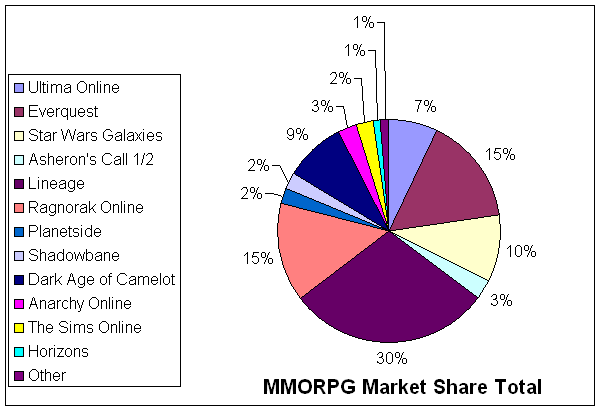
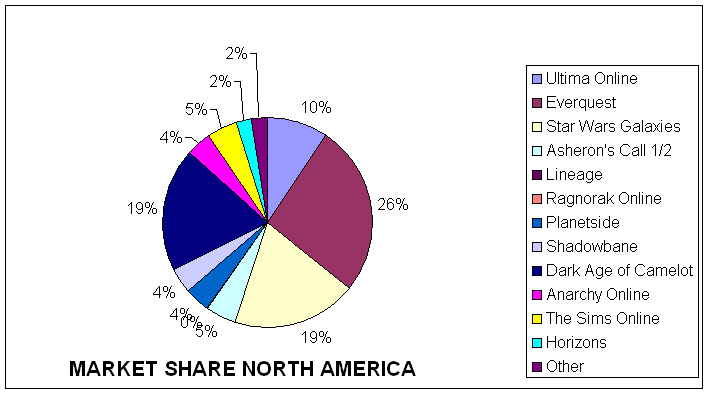
These charts show the market share that each game owns. Chart 1 shows both the North American and Asian marketplace combined. The next chart reflects just the North American and European market. As you can see, there are some major differences between the two.
<snip>
The Sims Online
Released 2003
65,000 subscribers
EA could be holding four aces in their hand and still manage to lose a pot. The Sims was one the most popular computer games ever. Millions of copies were sold, many to non-gamers. The Sims appealed to a wider variety of gamers than traditional sword and sorcery and even appealed to the ever-elusive female gamer. To capture this market in an online subscription based setting would be groundbreaking and profitable. Like SWG, The Sims Online opened its doors with a massive ad campaign, and an expectation of half a million players. In less than a year, TSO has less than 75,000 active subscribers. Instead of appealing to everyone, the Sims Online appeals to almost nobody. EA was stuck with another loser on their hands, and one has to wonder how long before they shut the servers off on this game.
Pro: Not too many silver linings. The basic concept is still strong, with an appeal that could conceivable bring in new players to online games.
Con: Like Ultima Online, EA does not have the skilled staff needed to do the kind of radical re-vamp needed to make the game fulfill it's promise. TSO is a title that will probably never make money for EA. It's clear that they will be canceling the game some time in the immediate future. No new expansion is officially planned, so it doesn’t look very promising for Sims players.
Prediction: This game won't be on the 2005 wrap up.
Recommendation: EA will need to publish a major release that would hold an appeal to those who tried the game and didn't like it, as well as those who never tried it in the first place. If EA could release a major Sims Online expansion and tie the marketing into The Sims 2, perhaps it would have a chance. Still, the window is rapidly closing and no action seems to be in the works. EA may well choose to just surrender online games to Sony.
An Analysis of MMOG Subscription Growth – Version 8.0
March 2004
Introduction
<snip>
Firstly, I rely on the companies and employees themselves to provide the bulk of the data. The numbers they give could be completely made up, and as Enron taught us, even financial reports could be misleading. However, given that none of claims seem highly outrageous, and that all companies are equally capable of lying, it would seem that the numbers given are pretty close to the truth. There is probably some minor fudging involved when a company wants to claim a major milestone, rounding up to the nearest 5K or 10K increment. But at the very least, the relative comparison between MMOGs is retained, even if individual data points may be off 10% or more.
Secondly, there’s no universal consensus on what constitutes an active subscriber. Some companies may count players currently on their traditional first “free month” as a current subscriber, whereas others might not start counting them until after that period and the customer actually chooses to subscribe. Although the accounts that don’t subscribe get “subtracted’ a month later, such accounting could create a continuous effect of inflating the overall subscription total. Most MMOGs probably do this, but some may not, and this may make them appear slightly larger than they actually are. Still, after the initial launch of a game or an expansion, the actual monthly effect of such accounts should be relatively minor… perhaps on the order of 10%.
Finally, a “subscriber” is generally counted as an individually numbered account currently in a company’s billing system. In some instances, one person may maintain multiple accounts, and thus be double or even triple-counted. Some MMOGs may even encourage this behavior more than others. There isn’t much I can do about this fact; again, the effect is probably minor compared to the overall population of a given MMOG, and in any case it’s certainly valid to count such multiple subscriptions if your goal is to evaluate the relative market share of each MMOG.
<snip>
SOURCES AND METHODS
Many people have asked about the sources of my data points, as they are not documented. I have considered doing so, but it is difficult to completely verify every data point on my chart. In fact, they sometimes change from version to version.
Most of the data comes from press releases from the companies themselves. Verant/Sony (EQ), Origin/EA (UO), and Mythic (DAoC) have been particularly good at doing this on a regular basis. Much of the rest of the data comes from news articles in a variety of industry magazines and web sites. I have tried to be careful to only select those reports that contain “official” numbers given in response to a reporter’s request for information, but in some cases they are estimates at best. Still other numbers have come from “off the record” numbers given to me by trusted insiders, or in less public forums like the MUD-Dev Mailing List. In a few cases where numbers seemed to conflict, I have picked the one that seemed the most reliable and which seemed to fit with the other data. The upshot of all this is that these numbers should not be taken as gospel. They represent the best research to date.
Despite all this, some people continue to question some of the numbers and so I’ve designed a simple, easy to understand ratings system for each MMOG I put on the chart. This rating gives the reader an idea of just how reliable the numbers shown on the graph are, and how much weight one should give them. The ratings are:
A – This indicates that the vast majority of the data points shown come from either official announcements by the companies involved or reliable inside sources. The numbers can be considered reliable, although a few of the data points may be incorrect.
B – This indicates that while some of the data points shown may be official, a substantial number come from press articles, unproven inside sources, or other indirect means. The numbers may not be exact for the MMOG in question, but are certainly in the ballpark.
C – This indicates that most or all of the data points provided are merely industry “best guesses” or are otherwise questionable. Usually, I will not chart MMOGs that rate C or lower. Their numbers should be taken with a large grain of salt.
D – This indicates that no data is available for this game at this time, but I expect to get something chartworthy on it in the future.
I am also trying to restrict my chart to truly “massive” MMOG games. There are numerous smaller MMOGs, graphical MUDs, and other boutique games that one could chart if one wanted to.
<snip>
The Sims Online (Confidence Rating: B)
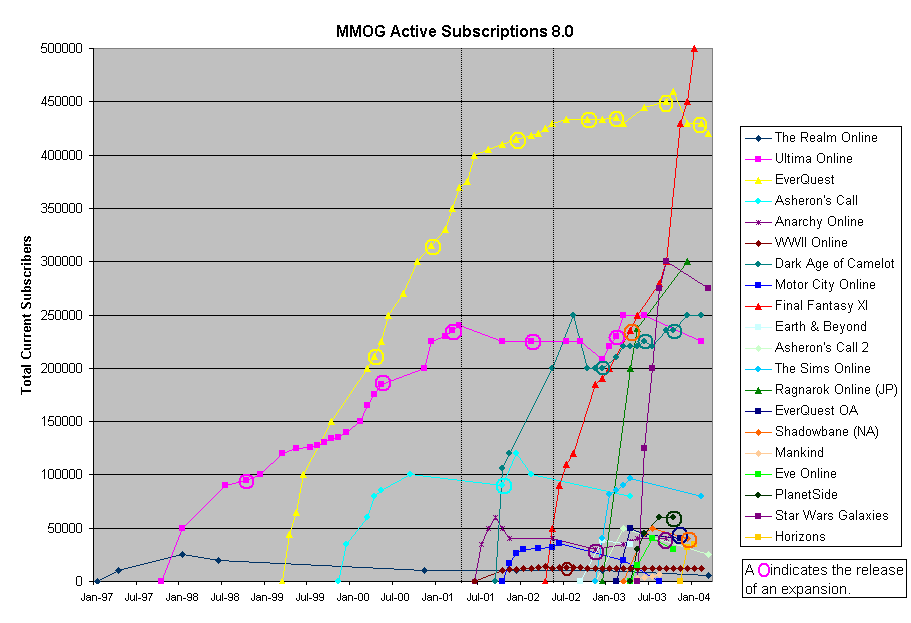
TSO has not been the runaway success EA had hoped for -- they initially projected 400,000 subscribers by the end of 2003, then they cut their expectations to 200,000 by the end of the year shortly after the game came out. Now they are saying they anticipate only 125,000 players by May of 2004. The disappointing subscription figures for the game have been widely reported in various news articles, although with some conflicting numbers that took me a while to sort out. I don’t believe they have broken 100,000 subscribers yet (I fully expect a press release when they do), and their last official report of 97,000 subscribers was in April of 2003. Estimates put the current number at closer to 80,000. http://www.thesimsonline.com
<snip>
For those who want to examine the actual numbers used to construct the graph, here is my Excel spreadsheet.
Bruce Sterling Woodcock
sirbruce@ix.netcom.com
Corporate history: expenditure, plans. Annual report 2004?
GiGNews
GiGNews writes in May 2003 (see also the MMOG chart at that time),
The Themis Group, a provider of player relations services for massively multiplayer games, recently released a report predicting that online game revenues would soar to over $600 million during 2003.
<snip>
Once subscribers sign up, they tend to stay with the relationship until something changes. This explains the industry’s current 72%+ renewal rates (Online Publishers Association) And what some gaming companies seem to be missing is the fact that while it may be more difficult to get subscribers to make the first purchase, it is a much easier task to get future sales (renewals). Not only does it take a lot less effort to keep an existing subscriber, but subscribers tend to buy other products in addition to their original subscription.