|
Subject data: The Sims Online
Sam Humeid -- 18 years old Diary introduction
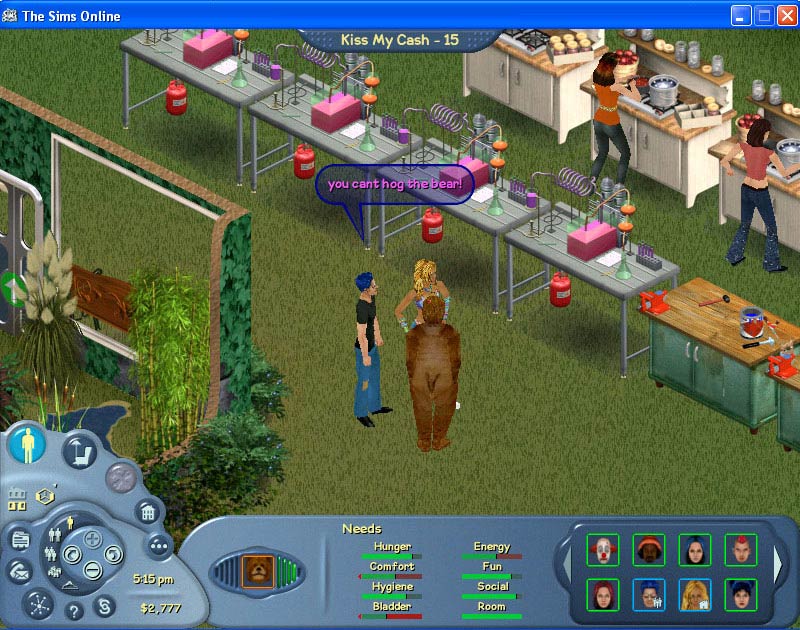
First session 2002.12.22_03-04-54.dv We see SH reading a hint before creating his first Sim. He is instructed to choose where he wants this Sim to live, and told that "Each city can have thousands of residents and can develop into unique communities, depending on the Sims who live there". (First tape, 00:00:17 -- so 17 seconds into the game) Same tape. SH is responding to a menu asking him to select a city. "If you consider yourself to be the industrious type, the good life begins in Alphaville!" The emphasis here is clearly on making money and thus acquiring wealth, which allows you to lead "the good life". This is the same consumerist vision we see in The Sims. After quickly reading the other profiles, which all read like real estate ads, he choses Alphaville. In fact there is very little to distinguish these places from each other; they are all billed as paradises of residential development in sites of pristine and stunning natural beauty. You are then asked to create an "alter ego to represent you", and you are given a selection of 226 outfits and 234 heads. You are also provided with a profile template where you can enter "Fav. music", "Fav. movie", "Turn ons", "Turn offs", and "Quote" -- the type of profiles common on low-end friendship and dating sites. You are told you can have three alter egos, but only play one at a time. You can switch between male and female sims and three gradations of skin color. SH choses an insect head, a white short-sleeved shirt, and black pants. He finds a name and enters Alphaville. The opening shot is a panorama of an archipelago of green islands. A hint tells him "pulsing lights indicate where the other players are right now" and to press "Most Popular Places" to find the "social hotspots". The focus of the game is clearly social, and the assumption at this point is that the player will be primarily focused on meeting others. Zooming in, the close-up reveals that the green islands have been subdivided into large, spacious, and identical green plots, cut into squares of 16 houses each by a grid of paved roads. "Alphaville" is a suburbia without even a hint of city. This extends -- so far -- the model of The Sims. A hint shows the rhetorical question "Where are all the people?" The answer: "They are in the properties that have a pulsing highlighted background." Indeed, some of the green parcels, in which each house is positioned, have a lighter, pulsing hue. As SH clicks on properties, the monotonous or homogenous plain changes into idiosycratically built houses, mostly mansions. There is a "property page" to click for information about "who is on it" before entering. The occupants of a property, perhaps somewhat incongruously, are called "roommates", and a gray thumbnail "means that roommate is not online" (00:02:23). SH clicks on "Caesar's SimPalace Casino" and joins it. There are no sites to join beyond these private houses. He is greated by an interior and an "Okay, now you've made it to where the action is." He is also told that "To chat with the other Sims, just start typing and press return. To interact with them, click them to see a menu of options. To make you Sim do a gesture, click yourself." In the background, we now see rounded purple talk squares where named speakers MuscleSim says "hehe" while Diamond says "hello Fred :) welcome to Caesars". Fred now also sees his table of "Needs": Hunger, Comfort, Hygiene, Bladder, Energy, Fun, Social, and Room, all fully green. The game has started. 2002.12.22-03-13-15. Fred removes the hint obscuring the central stage and reveals himself standing on a sidewalk next to a garbage can, a mail box, and a phone booth, right next to a man who faces the other way. Fred clicks himself to see what his options are for making contact and selects "Silly" and then "Fart" -- yet this effort at making social contact is ignored; the other Sim does not turn around or in any way acknowledge Fred's presence. Fred walks past the other Sim and enters the building, sees a pool game in progress and instantly clicks "Join". However, he can't figure out how to play pool and the other sim just plays his own game; Fred moves on. The disembodied voice of "Diamond" keeps asking if there is something he needs. It's unclear if it's directed towards Fred or not; in any case he takes no notice. Fred finds an excercise room and starts working out; he spends some time standing by another sim working out, but again he is ignored. His "Room" need is rapidly turning red. The people present are shown in the "Sims page", and the hint tells SH that he can "send them a message, bookmark them, ignore them, find out the age of their sim, their skills, their interests, where they live". He clicks to get the profile of a female sim, Darcy M. Remington, and clicks on an icon to see her "Friendship Web". The web, at 00:03:33, is illustrative. It shows Darcy connected to nine close friends and eight distant ones, each of which can be clicke to reveal a name and a certain number of days. When clicking the profile of "Elvis Presley", Darcy says, "This is a great friend check out his place!" Friendships have a time dimension, and they are recommend each other. However, the recommendation is given in the form of an advertisement: "check out his place". As Fred's room need is becoming acute, he could perhaps use this information. Fred clicks on an object that says "Bash the pinata"; the hint says "This solo object will allow you to make money. You can use these objects alone; however, you can increase the amount of money you earn by working with other people. If you are near other people who are working on similar objects, everyone will earn more money." (00:04:00) Skills also make you money faster. There are also "group job objects" where you make money faster. The skills rule is inherited from The Sims, but the "working with other people" rule is new. Why did the designers of the game decide to build in an incentive for working with others in this manner? Its purpose is not hard to infer: this is the game's way of encouraging people to socialize. This notion of socializing, however, is wholly vacuous, as the definition of "working with other people" is merely doing the same thing in their proximity. There is no collaboration; instead, there is the establishment of an instrumental relation between the players. In this sense, the incentives are not well targeted: while the only plausible purpose was to encourage socialization, the rewards can be gathered without any socialization at all. What Fred learns is that money is what counts, and you should stick around others sims to get money faster. This message is underlined by the fact that the online world is populated by individuals who have so far been oblivious to him -- although he himself has made only the lamest attempts to initiate contact. After his first attempt to be funny, he is quickly moving into money-earning mode. His one social discovery -- that people have friendship nets -- leaves open the possibility that there are also emotionally regulated relations, although the advertising clause suggests that even such friendship webs may be largely instrumental. 2002.12.22-03-19-42.dv After spending some time alone in a jacuzzi, SH's sim Fred disappears off the screen for a moment, and when SH finds him again he is standing next to a young woman in a bathing suit. SH frantically clicks on Fred to initiate contact, but the girl walks off before he can do anything. He then fumbles to greet a second sim, offering a wave, but she walks right past him, ignoring him, before the wave is executed. Like a fool he waves to the wall. Social life in TSO is not pleasant or easy. He sees the girl again and tries to walk up to her, but fails to give the right instructions. He loses sight of his sim and finds him waiting still on a corner. SH zooms out, leaving his sim Fred Mandibles standing. He selects a different property and moves Fred to it: The Masquerades Nightclub. He is greeted by Pierce, who tells him "Come on in! Try on a costume and hit the dance floor!" [Is Pierce the owner of this location, and was Diamond the owner of the previous?] SH presses Quit and confirms; at that moment, he is accosted by two girls, one of whom is facing him, the other facing away. Too late; he is logging out. This was SH's first session -- it showed some promise, but the experience appeared to be
mostly embarrassing and frustrating -- let's see what his notes say. Diary on the first session SH writes that Fred Mandible was "a character I developed to
understand the game. This character has been retired today. I didn't
really develop the character fully because I knew he wasn't going to
last." 2nd session: T-008 to T-009.dv (black and white) Diary on the second session SH writes, "I chose to develop this character because he is the
closest thing to my alter ego. I needed an outlet from that ego in
order to help myself in real day to day life. I'm hoping that I'll be
able to learn from my other self and take those characteristics that I
feel I lack and forge them into my real life." (9) SH continues, "So far "Sammar" has done fairly well in getting to know his way around. He has visited a few different places. He's gotten a roommate, "Kelli M", who also is a beginner. And he's made a few extra bucks making pizza. Not too bad for a first day. His frustrations are asing too with all knew [sic] knowledge and info he gains. His main goal at present is to make enough money to build a party pad by the beach." (9-11) "A lot of the people I've visited at their properties have been exceptionally nice. I imagine it has to do with their visitor bonus. The people I met in the pizza place are not nearly as friendly. It's amazing what greed will do." (13) FFS' comments on the screen recording SH begins by designing a second alter ego, this one more attractive-looking: a well-built man with fair hair and semi-casual khaki clothing. He fills in his music preference as "Electronic and Classic Rock", his favorite movies as "Maggots from space", turn ons as "A good sense of humor, independence", turn offs as "Egos, codependency" -- long pause -- and "bad attitudes". His character is called 5ammer (he keeps getting versions of 5am rejected). What we see in this second character design is a clear attempt to make himself socially more attractive. The very attractive-looking young woman he twice attempted to get in contact with may have inspired him -- either directly, to want to be more attractive himself, or indirectly, by demonstrating to him that online sims are also judged by their appearance. He spends a full ten minutes designing a sim; the first time he spend less than a minute (verify this). He signs on, but the session appears not to have been recorded. 3rd session: T-010 This shows a Sims Online web site, with message boards. 4th session: T-010 00:00:20 This session shows the Fred Mandible sim going back to Alphaville, to a new house by the sea. The session only lasts a few seconds. 5th session: T-011 (black and white) This session shows Sammar, the good-looking sim, in Blazing Falls, speaking with Katie M, an attrative young woman in slacks. He sends a letter to Katie that says, "Find Me I'm lost LOL". He looks at vacant lots and appears to want to buy one. A sign comes up, "Do you really want to buy this property? You have $10000 in cash and this lot costs $4242." He clicks no. He is confused about something and calls up "The Sims Online Player Petitioning Help" screen, which offers him help on "How to Ignore & Avoid Another Player", "Complain about a Player", "Hints and Tips", and "Ask Now". He cancels. He "flies" over the landscape for a long time (panning the map). He joins a property called "Chateau Sirois". Again he's placed on the sidewalk, next to a trash can, a mail box, and a phone booth. There are no cars or roads down on the ground in TSO -- you see the roads only from above, and they are not there when you "land". He doesn't know what to do, but as the walls move away automatically to give you a view of the inside of the building (a feature inherited from The Sims), he sees someone sitting and reading inside and tries to greet them. Again, he is unable to get any acknowledgment of his existence -- this time understandably so, as the person sitting inside may not see him waving. It looks like SH has forgotten he is present as Sammar and is not visible himself -- if I can put it that way. While he persists in trying to greet the sim, it suddenly vanishes. SH returns to his sim by the gate and walks down the sidewalk to another house. A couple of smaller files are lost, but it looks like the session continues. T-014.dv He is now in "Skittles Beach Party Pad". The file is B&W, so I can't tell for sure, but it may be that his needs are in the danger zone. He clicks on "Fun" and finds that "Fun is different for everyone. Depending on what kind of Sim you are, you may find reading a book more interesting, while other Sims may be more likely to enjoy a little pinball action." He clicks on "Social" and is told that "Sims are social creatures, and they crave social interaction. They can fulfill their social need by interacting with roommates, friends, and neighbors. They messaging system is great for writing people over." (? hard to read) SH calls up the help screen and types in "messaging". He is taken out of the game and to the web site, which has 77 answers to his question. He skims a dozen without finding what he wants. Clearly, the cost of learning how to play this game is quite high. He adds "instant" to his query -- he already knows how to send a letter, but he wants chat. He fails to find an answer and returns to the game. T-016.dv He is Sammar in Blazing Falls and joins the Skittles Beach Partypad. He meets DJ Skittles but doesn't appear to know what to do to talk to him -- he gets all kinds of options to walk places and to swim, or take a shower. He goes for a swim and uses the restroom. His hygiene bar is improving. He clicks on other Needs items; the file is B&W so I still can't see if he's in the danger zone. He is now franticaly trying to get food and possibly sleep, but still can't find a way to communicate via chat. Clicking on DJ Skittles, he has the options "Greet Nice Romance Play Mean React" -- but no "Talk"! He switches modes and gets the options "Idle Silly Happy Cool Dance Moves Mad Sad" -- again, all useless: he needs to communicate. He figures out how to gain admission to the house ("Get Entree 60"), and appears to find food. As he walks into the sitting room with it, right past the owner, he appears flustered still and searches frantically around for a way to communicate. He finds he now has the options "Applaud Boo Flirt Compliment Berate Insult Tease" and selects Compliment. He has just walked into someone's house, taken food from their fridge, and sat down in their living room, and he wants to say thank you! He clearly doesn't know the game, but the options he finds are just as clearly inappropriate to the situation. TSO is weird: everything is private, but at the same time this means that in the last analysis nothing is, since people have needs that must be satisfied. T-019.dv (color) Sammar is again at Skittles Beach PartyPad; the owner is by the pool painting a picture. Music is playing (we don't hear anything, as the S-video cable doesn't capture sound). Finally, he figures out how to use instant messaging and contacts DJ Skittles, typing "hey dj skittles". He gets a response, "hey". Finally SH gets to be polite: "sorry to invade your house. jst trying to figure this place out" So this is the reality of this hyperprivate world: you have to walk into someone's house in order to survive -- to go to the bathroom, take a shower, eat, and sleep. SH appeals to DJ for understanding: "jst trying to figure this place out" means "I'm a real person playing a game of pretend, and I'm having a hard time understanding and applying the rules". DJ writes back, "nah its cool". It's not entirely clear at this point whether the relationship is formalized into a roommate arrangement. Is DJ just being friendly, or is he benefiting from Frank's company and is just saying "the game puts a premium on socializing, so we both benefit from this"? Now, for the first time, after several sessions and at least an hour of play, SH finally gets to ask someone: "any tips on what to do" -- but erases it before it's sent, changing it to "any tips on the best way to start?" In the meantime, DJ has written, "dont worry about it". He may just be being nice. He spends the morning (?) painting, and is soon joined by another sim. DJ responds, "try to find a place that busy with people what and make friends". Sammar writes, "my friend kelli lives here in this city" -- so that's the girl he spoke with earlier. Yet in the language of TSO, this is a misfire: TSO "friends" may not need to be anything like a real friend, and real friends as such don't count. The rules of the game make you "need" friends, but what passes as a friend remains an instrumental relationship. There is nothing in TSO friendships that stipulates you treat people as an end in themselves. Now, you might say, DJ does. He reassures SH that his sim Sammar has not offended him and he provides free advice. In this way, DJ relates directly to SH rather than to his sim. He shows no interest in Sammar. This ends SH's first tape. SH Diary 22 Jan 2003 On Sammar, SH writes, "this character has made huge strides
in his skill levels. Interaction between "Sammar" and the other
characters has increased dramatically. His logic skill is up 2 notches
and his cokking skill is up a notch and change. His interaction and
friendship with people is increasing mostly due to his helpfulness in
clearning and other household duties." (17) FFS: Note how SH is very keyed to what the others think of "him" -- he is keen to be liked"Sammar is feeling accepted in this community. He is still figuring out the finer details but it's coming along well. He aspires to make his skills at their peak and make as much money as possible." SH Diary 23 Jan 2003 On Sammar, SH writes, "He's figured his way around, and his skill levels are constantly increasing as is his money levels are increasing [sic]. He's building a friendship base that's making him money and skill." FFS: Note here, on Sammar's third day of play, SH is focusing on skills and money levels, and subordinating friendship as a means to money and skill. The next diary entry is three weeks later.SH Diary 18 March 2003 On Sammar, SH writes, ""Sammar" has built his skill levels, mostly mechanical & logical, and is making a decent amount of money making gnomes. He has a home now and is in the process of building it up to be a place where other sims can come to relax and make money." (25) FFS: Having a good time hanging out continues to be a theme for SH."My character's main goal at present is to be a viable and successful character who can help other sims in their money and skill earning endeavors." (25-27) FFS: Again, SH is altruistic, oriented towards community creation."The game part of the Sims is somewhat boring because character development is almost in real time unlike other sims games where I can fast forward through time. I think an offshoot room where people can separate from the game and chat or have some other activity like a sims poker room would make the game far more interesting." (29) FFS: SH is expressing a desire to interact with people outside of the confines of the Sims world or the avatar and actually play a game with others -- even just a game of poker! This is a good illustration of how the creation of a virtual agent is really breaking down.SH Diary 9 April 2003 On Freakstick, SH writes, "I started Freakstick today to retry the sims.com. Freakstick has a skinless body. He sorta looks like the anatomy figure from highschool biology class. And his head is a mask that's part tribal part the big blue character in Monsters, Inc. played by John (35) Goodman. I chose to develop this character to express my off the wall personality, as opposed to my other character "Sammar" who is whom I'd like to be in real life, an alter ego, if you will. I wasn't sure if Freakstick would be accepted or understood, but surprisingly people are eager to talk to him and make friends. His friendship circle is plus 2. His mechanical skill is up to 3." (35-37). FFS: The player's goal has now been reformulated: to "express my off the wall personality" (37) rather than to "learn from my other self and take those characteristics that I feel I lack and forge them into my real life" (9). The goal is still social -- a kind of exhibitionism, but perhaps aiming to test whether this "off-the-wall personality" will be accepted, as a test bed for whether it might also be accepted in "my real day to day life" (9)."Now that I've learned the main tricks and tips in succeeding in the Sims, I have a new way of going about things. I plan on amassing large amounts of mechanical and logical skill. Those skills have the greatest amount of financial profitability with the least (39) amount of constant attention." (37-39) FFS: This brief formulation of strategy appears to be close to what the game supports in that department, short of mob-related extortion and prostitution."The game would be more conducive to chatting if email were accessible while playing to swap pics and personal info. A real possibility of meeting these people off line would get the place buzzing." (39) FFS: The subtext here is that the sims that you encounter in the game doesn't really feel like real encounters. They are not emotionally satisfying or engaging, and thus do not draw people in. Nevertheless, SH remains positive and appreciative:"The characters at night are really cool too. Very generous, and accomodating." (39) SH Diary 7 May 2003 "So I'm developing Freakstick logic skills. He's become roommate with two girls from NY. People really seem to like Freak's look which surprises me." (41) FFS: Although SH now has an avatar that has two girl roommates and is well liked, he's detached from the social scene. His focus is elsewhere:"My goal right now is to make as much money as possible and to build my friendship web. I want to own a house soon and make it into "The Place" to see and become a Sims lord." (41) FFS: Cultural comment -- being a minion is no fun; SH is now thinking in terms of social hierarchy. Note that he's using "I" here -- these are goals of the player, not of the avatar."The people I've met so far are pretty cool." (41) FFS: Again, here there's an overlap area: the avatar has met other avatars, but the player has met other people."I've also started (43) learning of all the different things I can do to make money and skill points. The start of the game is still really slow. The building of skill takes forever. I wish there were a way to gain skills faster. I foresee myself having enough money to start a profitable house within the next 10 game periods." FFS: Note that SH continues to speak of character development, especially early on in the diary. Slowly the language drifts towards "building of skill" or "money and skill points" -- a disasterous flattening of the development of the virtual character."In a perfect world a separate area just for chatting would be great. A setup with regional room choice would be optimal." (43) FFS: SH still wants to exit the game to chat, get away from the skilling and working -- in spite of the fact that the game has excellent built-in chat features. He also wants to meet people who are geographically close to him, whom he could meet in real life. SH Diary 27 July 2003 SH went on to build skills but there were few people online so the effort didn't pay off as much as hoped. "Maybe there will be more people the next time I log on." (45) FFS: Note that SH is now speaking of people as instrumental in speeding up the gaining of skill points; he is no longer interested in socializing or meeting friends. SH Diary 4 August 2003 SH writes on Freakstick, "I'm continuing this character because I have invested time to build his skills up and his money a little bit." (47) FFS: Now SH's relation to his avatar has become increasingly detached -- he is no longer interested in trying out new traits or even showing off. The logic of the game grinds sociality out of him."My ultimate goal, still, is to gain enough skill and money to build (49) the ultimate house where I won't have to work at making money. Rather I earn money by collecting the revenues given to me by the sims for visitors coming to my house. Also I will get residuals for every dollar that my guests make." FFS: SH is now fully converted to the logic of the game: it is not about human relationship at all, and there is no room for charity (as in his earlier desire to help others). The logic of TSO is to live off the labor of others, reducing the primary significance of human relationship to one of instrumentality. SH Diary 26 August 2003 "My goals for Freakstick remain the same, to build skill and eventually make more money." FFS: Note the formulation: "My goal for Freakstick". This suggests the player sets the goal, but the avatar owns it, or the goal must be displaced onto the avatar as if it were his goal -- it is Freakstick that lives in the world where skills are acquired, and he stands in for the agent that acquires this skill."The time it takes to build skill is a little overwhelming, not mention boring. But I feel it will pay off soon and my house will be my reward." (51) FFS: Here SH is bored and tries to motivate himself by saying "my" house will be "my" reward -- a bourgeois yearning. It is not difficult to identify with the avatar as the virtual agent who owns the house; this is the part where there is perfect overlap. In the offline version, the player might feel he or she owns all the houses, even though they are inhabited by various sims with whom the player does not identify. SH Diary 1 September 2003 SH writes on Freakstick, "The goals remain the same. People are a little more chatty tonight so the game isn't nearly as mundane but because it's a nationwide assembly of people it's difficult to transcend the smalltalk and delve into more meaningful conversation." (53) FFS: SH is very gentle in his complaints, trying to be positive. Yet there is nothing to talk about within the game -- in itself a phenomenal achievement -- and the game in effect is a distraction from actually talking with people. This is no doubt because in the game people meet as avatars, and the avatars are not citizens in any meaningful sense; they are sweatshop workers, demoralized, bored, and underpaid; they have no subject position from which to chat. You would need to remove the sims and let people meet directly -- but the whole point of playing a game like this is that you interact in the virtual reality. So the virtual reality is so poor in itself that there is nothing to delve into, no strategic world to explore and share information about, just mind-numbing repetitive labor."I think if it were more regional people would be more willing to meet offline." (53) FFS: SH continues to look for solutions that would allow him to actually make contact with people, to have meaningful conversation, and his solution is that this will only happen if the people could meet in real life. This shows how utterly the game fails in providing a virtual world that stands in for real life. SH suggestions typically amount to terminating the game and doing something else. SH Diary 28 September 2003 SH writes on Freakstick, "Tonight was a little more interesting than previous play experiences. I made a tidy sum of money and got involved in many activities thrown by different home owners. I think I finally have a basis on which I can design my future home. I think by year's end I will have my house and the dynamic of the game will change completely." FFS: This is the last entry. The argument is hopeful, but a bit strained. SH appears to have failed to convince himself that "the dynamics of the game will change completely" and never played again. Second subject -- female The second tape is dated 2002-12-30. T-001 It starts out with "Your Three Sims: Which One Do You Want to Play?", and none of them is defined yet, so this must be our second subject, kelli. She reads the same opening instructions about choosing a place "where you would like the Sim to be" -- the language is kept non-committal: not "live", just "be", which might mean "hang out". The heading says "What City Do You Want to Live In?" but they are all residential estates, "prime real estate" -- including the peak of Mount Fuji. T-002 She gets a game update. The game company is Electronic Arts, whose motto is "Challenge Everything". Very ironic -- TS and TSO seem wholly devoted to the mainstream, the uncontroversial, an extreme version of the middle-of-the road, the implementation of social conformity -- try to put this better. The social vision that EA has embodied in TS and TSO is a consumer utopia, specifically a utopia of domestic consumption. The game has elided every communal function of society, such as governance, policing, education, recreation. Yet this privatization of the entire world of the Sims encounters certain difficulties, certain contradictions. The game designers don't want to make it impossible for their players to keep their sims alive (this would destroy EA's business), so they create a society that is on the one hand wholly private, yet the meaning of "private" is changed. For instance, you cannot steal things in TSO. As you always benefit from having someone visit your place, the whole significance of private property has changed. In the real world, the purpose of private property is to allow the individual to benefit from the fruits of his labors. This creates an incentive for him to work harder. This element is carried over into TS and TSO. What is different is that in the real world, there is a distinction between public and private space, and TSO essentially turns the private, non-productive suburbia of TS into a productive business environment. This transformation turns what was an essentially private, nurturing, decorating, feminine world of TS -- a world where workers were replenished, rested, and fed, and their skills cultivated in elementary ways. So this transformation in effect turns the consumer-oriented, non-productive, private suburbia of The Sims into one vast entertainment colony, as everyone vies to attract others to their house. Yet the underlying structure remains private: there are no public spaces, no projects that can be truly undertaken in common, although each player benefits from the proximity of another. In brief, the game has no feature that would allow two or more human beings to formulate a goal and take steps to use their combined resources to realize it. This creates an environment where the significance of the sims to each other is one of pure instrumentality. The problem is not simply one of institutionalizing (find a better word) selfishness and immorality; the real problem is that the design of the game fails to provide the affordances that would permit the very real potential for fruitful collaboration to be realized. This failure to provide the infrastructure that would allow cooperation to happen expresses itself most simply at the level of information. TSO is a remarkably uncommunicative world; apparently, there is nothing of significance to communicate. Advanced communication functions are built into the game, but the content is trivial. The obvious reason for this is that Sims don't coordinate their activities. The game fails for a single, simple reason: there is no shared purpose. Or more fully: there is no facility within the game for formulating and pursuing a shared vision. This is radically different from other multiplayer games, where the players have a major say in the ways in which the games develop. In fact Mortensen's thesis is focused on the transformation of players from consumers to producers. This is a transition TSO fails to make. Economic production in TSO In TS, you can practice skills to be better paid at work. Mari says that in TSO, you can also cash in on your skills. Say you spend time "studying mechanical". You can then go to a particular device where you "produce" something, quite mindlessly, without any actual input from you, and this results in money being credited to your account. There is no raw materials to purchase, no prototyping, no marketing, no sales. Increased wages are a measure of your increased value to others. In both TS and TSO, you can acquire this increased value. In TS, the fruits of this is that you are better paid at work -- a sufficient and proportionate reward. In TSO, the point of the game is that you can interact with others. In social interactions, Fred Mandibles found it painful and embarrassing to be so consitently disregarded; it was clear that his value to other sims was close to zero. Only to the owners of houses he visited did he get a friendly greeting, and this greeting may well have been preprogrammed (find out about this -- certainly they may have been from Fred's point of view). Now, if Fred had some way of making himself more valuable to others, that would be great. For instance, if he could increase his charisma, others would be naturally attracted to him, as he was naturally attracted to the bikini girl. Yet his charisma point have no effect on the bikini girl; she does not find him more charismatic. His skills, which should make him more valuable to others, don't in fact accomplish this at all. This means there is a near total disconnect between the cultivation of features that that game tells you makes you more valuable to others -- admittedly, in a purely economic sense -- and the reality of your impact of your skill levels on your value to others. This disjunction leads to a highly unusual social situation: in TSO there is almost no differentiation between individuals. There is no way to matter to others by providing them with a unique type of benefit, because your skills don't benefit others. Incidentally, this feature could easily be changed. When practicing with others, you could be given more points if the other players are already highly skilled -- and your own skill levels could progress faster if you accepted a lesson from another player. It turns out that "sims will hire other sims for work; but only those with high skills"
(Alphaville News, March 26, 2004) The PC Review from Jan 2003 (source): The available "jobs" leave a lot to be desired as no true careers actually exist in this game. Players merely drag their Sim from one location to the next, doing things like carving gnomes, making preserves, creating potions, or solving problems on a blackboard. The fruits of these labors can then be sold to thin air for chump change.
Now, there are situations where there are differences in value between individuals. For instance, DJ is valuable to Sammar because DJ has a restroom, a shower, and a fridge. Yet this value is in the nature of a power relationship; it fails to activate the emotional system. That is to say, the fact that DJ has resources Sammar needs doesn't make SH perceive DJ to be a valuable friend to have -- the resources are simply available for a fee, and DJ has no incentive to stop him from taking advantage of them. The point here is that for someone to become valuable to another, you have to be able to provide me with the tools of your power, either by training me, or by entering into a repeatable transaction with me. I need to feel that my increase in power and ability is something you want to happen, for its own sake, because we are allies in some sense. By creating allies, people develop a confidence that they will continue to engage in mutually beneficial transactions together. So you could use the prisoner's dilemma type of thinking to argue that TSO does not provide the code that allows people to solve the prisoner's dilemma. In TSO, it will typically pay to defect. This means that the critical resource in TSO is not friends and collaborators but suckers. Back to 2002-12-30 and T-002.dv Kelli has just updated her game and is displaying the EA Games logo and the motto "Challenge Everything" (tm). She is returned to the "Your Three Sims" screen, but does nothing for about a minute. She choses Blazing Falls and creates her first sim. In her notes, she describes how she is trying to find a sim that looks like her. She picks a blonde head and sticks with this first choice. She then tries out a very large number of outfits before settling on a pair of worn jeans and a black jumper that shows her midriff. She tries to call the sim Kelli, but the name is already in use. She settles for Kelli M. She is taken to Blazing Falls. As she descends, a housing development appears; as the details load, some of the uniform houses morph into individual mansions, some of which pulse. She starts using her "most popular" toolbar, which shows her "Most Popular Places" in various categories: entertainment, welcome (?), money, romance, residence, shopping, and skills (?), as well as an icon for "Places I Have Visited". She zooms out the see the whole world of Blazing Falls, which now displays the most popular places, or houses with the most people. She selects "Skills" and selects a house called The Logic Factor. She joins it -- and her needs now appear in the bottom pane, all green. She walks in, finds a pool table and starts her sim playing. Then she quickly looks around the whole place -- there is food, a swimming pool, several rooms -- a full resort. There is not a single person in sight. Finally she finds someone sitting in a computer room; she immediately gives the command to walk there. It is clear she was looking for others. T-005.dv However, her sim is not responding. She pans around, see the pool table again, with a woman playing pool with her sim. She gets ready to greet the female sim. However, she doesn't find the right commands in time -- though under "Nice" she finds "Talk" -- and the other runs off. Now she has seen how you can leave your sim unattended -- the other may already have tried to greet her? There may be no brains there to respond. During this period, her sim kept playing pool, and any new action commands were just added to the stack. She now joins a logic game with another sim -- it looks like a board game, but there is no discernible content to their activities. She finds a telemarketing device, where she can chose to "Make sales pitches" and make money that way. Now there's a useful social skill to pick up! A naive player learns that in the target society, you can make money by calling strangers and asking them to buy things. She reads the "solo object" rule (see above) -- this is the key rule for the Sims Online. The telemarketing instructions say, "If you work smart, you can make money much faster", but it's not clear what "working smart" means. The coordination rule: "When multiple people are working on multiple Telemarketing Systems in the same property at the same time, everyone's orders will sell for more money! The more people working, the more money you will make." Now this means there's a clear incentive to coordinate activity, so that everyone is doing the same thing at the same time. The information screen also says, "Also, the higher your Charisma skill, the more you will sell your orders for. As you improve our skill, you'll make slightly more money each time you complete a project." This is the skill rule, imported wholesale from TS. "The owner of the object gets kickbacks for every project you complete, but unlike you, they'll make the same amount regardless of your skill." Here we see a good example of the disjunction between what rewards you and what rewards others: your skills mean nothing to the owner, so there is no way to make yourself especially or even uniquely valuable. The place is almost crowded. Kelli M plays with Larry, a woman is watching, two women are practising their charisma skills before full-length mirrors, and six others are in front of computers, and two are sitting alone at tables. Nobody is talking. Above everyone's head is a blue cone (I don't see it clearly), indicating they are sims that are controlled by a player -- the exception is the woman watching; she appears to be a robot. In a sense, everyone is engaged, doing something, yet this activity is all autonomous, it is not controlled by the player. The player merely makes the decision to do something; then the automatic program takes over. From the player's point of view, this is hardly satisfying -- it is as if the boring part of TS has been ported to TSO, and the fun part of building placed out of bounds. A couple of minutes go by. This frantic activity is in itself boring and unattractive; what is the goal that would make this part of a coherent strategy? Kelli tries to initiate some interaction and clicks on her sim to find out what behaviors are available. She finds the interaction menu: applaud, boo, laugh, flirt, compliment, berate, insult, and tease. She clicks "Applaud", but the behavior is simply added to her list of tasks -- it would not be executed until she is done playing. This means that while the sim is engaged in one of these activities, it is simply not possible for it to do anything else! This is an ingenious piece of social engineering for docility. "No talking on the assembly line!" Is this really the case? Can you not do anything while practicing? Or could you do messaging? (Ask Mari). Kelli checks her friendship network and finds she has no friends; she is trying to figure out how to add Larry, the person she is playing the logic game with, to her list of friends. She searches her menues for a long time. Finally she finds his profile and clicks on his friendship web, but she doesn't find out how she can become his friend. She checks her own profile and finds she now has a logic point; a hint window appears that says, "Nice work! That logic point will increase your earnings potential at this object." The other categories where she can earn points are Mechanical, Cooking, Charisma, Body, and Creativity. Another pane appears, "The logic may escape some sims, but not Kelli M, who just received 1 Logic Skill Point". She then puts Kelli M by the computer and selects "Learn to use". Someone says, "What are you doing?" apparently addressed to a sim just standing there, his back to the speaker. A little later someone else says, "Did I miss something". This indicates that open conversation is in fact possible, but among these twelve sims, nobody thinks it's worth talking. While Kelli M is earning points by the computer, Kelli herself looks around and finds beds and various pieces of equipment, without investigating further. She then zooms in, and suddenly sees the skill levels of everyone involved. We now see that the two people alone at the tables are playing chess -- each is playing alone. Ridiculous, eh? It would of course be trivial to put a real chess game into TSO. Someone joins one of the players, and the original player promptly leaves. People don't even greet each other -- they have no significance for each other beyond the sheer fact of earning faster in each other's company. L'enfer, c'est les autres. A network error -- "your client may have erroneously disconnected or the server may have crashed" -- kicks her back to the login screen. She logs back in and goes to Blazing Falls. (T-009.dv) She joins the Bonds Skill Casino (?). The number next to the name may be telling her how many people are present -- this one says 2, while the Logic Factor said 16. She spots a sim and tells hers to walk over to it. She selects the chalkboard and gets this help screen: "Use the QED Chalkboard to create formulas and make money!" This is where intellectual work is produced; the money reward appears to be built into the activity; this is not a skill builder (is there a clear distinction?) She gets going, and now she talks to him -- how does she initiate this? She asks, "Do you get logic skill points for this?" The typed sentence appears as a purple bubble from her sim, as in a cartoon. He responds, "no money" (?) She asks, "does it take long to solve an equation?" I can't make out his one-word response. Kelli here is staying on topic and not just chatting; her interlocutor responds with the bare minimum. She now says, chattily, "I guess having only one logic skill point isn't gonna help me out that much. I'm gonna go get some more logic skill points." Leaving her sim in place, she zooms out. As the mouse moves over the landscape, property prices pop up -- you can't explore the landscape without being told what each lot costs, even if you have no interest in purchasing real estate. Kelli, however, has been distracted by this and clicks to purchase a vacant lot for $3043, spending her $10000 -- she has so far not earned anything from her formula writing, but her sim is still hard at work. So this is what you can do -- you can look around the online world and find out things about it while your sim practices skills or makes money. This might work for a while, as it solves the immediate problem of players being bored, but in the long run it will fill TSO with zombies -- which seems to have already happened. Kelli clicks to purchase but is presented with a warning. "Before buying your property, consider finding existing properties that need roommates. Having roomates allows you to buy more stuff, have more buildable space, and host more visitors (which makes you money)." The advice convinces Kelli to hold off on the purchase, which seemed an impulse decision and made at random. This warning presents a clear strategy, and spells out the trajectory of a successful
game. The goal here is to have more money, and the underlying logic is that having some
money will get you more, if you invest it in the right way. However, the warning is also
ambigous: how does having roomates allow you to buy more stuff? By becoming someone's
roommate, are you benefitting the owner or yourself? Is it mutually beneficial? In what
manner? Is it simply in the expected sense -- the sense that translates from the real
world -- that being a roomate is cheaper than buying your own house, but you don't build
equity? In TSO, do you build equity by being a roommate? In this way, this crucial piece
of advice doesn't disambiguate the situation. Does the game want you to be a roommate?
Here you lack information to make an informed decision. As far as I can tell, the warning given has an ambiguous
status. It may be that, with skilfull play, it's a good investment to
build your own house. However, if everyone did this, the game would
suffer. It is in the interest of everyone to get together and
"practice" skills and do work, but at the same time the owners are the
ones rewarded. Thus, you may be better off disregarding this advice and
act selfishly -- this may be an instance of the game itself providing
fraudulent advice to keep up the supply of suckers. Put differently,
being a roommate is essentially a cost, but the system depends on
it. Capitalism requires cheap immigrant labor. In contrast, here is from a preview of Final Fantasy XI:
Kelli returns to her sim and checks out her fellow formula maker, big 1 (?). He has several mechanical skill points, but no other skills. He has two inner-circle friends and one in the outer circle. She looks around at the house -- finds a bed, some other things (as if to say, is he a good provider?). Kelli M has now worked exactly long enough to come up with a marketable mathematical formula, and gets the option to sell the solution. Thus, the generation of mathematical knowledge is turned into something that can be done for hourly wages. Kelli types "I solved it!" She discovers what the formula fetched in the market place and types, "only $50 that is a rip off!" She zooms out to look at the most popular skill-building places -- these are the equivalent of schools and universities within Blazing Falls. She finds one called "Codes and Skills" and moves her sim to it. Note that Kelli is catching on to the purpose of the game in a far more systematic manner than SH. She is building skills and making money right away, and she is not expecting to engage in casual social contact. At the same time, she's friendly and communicative. The paucity of chatter may be caused in part by the fact that the game is poor in strategies. The warning Kelli got when she was about to purchase a plot of land pretty much spells it out. Note that Kelli pursues a different strategy: she is aiming for points and money through work, while the warning told her she should be looking to be a roommate -- and it was unclear how that would help her. Codes and Skills has 15 people and Kelli returns to the game she had learned before, to get more logic points. Someone is chatting actively in the background. For some reason she doesn't joint the large and chatty group. Instead she looks around at services provided for a fee: food and sleep can be purchased right there. A night is $20, a hotdog $16. She exits the game. In the next session, she returns to The Logic Factor and elects to make pizza. She finds out that "Four Sims are needed to make a pizza". So this is a "group object". She abandons this and selects "make preserves" instead. Thus, the production of mathematical formulas, pizza, and preserves takes place within buildings clearly designed as resorts, with swimming pools, exercise rooms, buffets, lounges, reading rooms, and decorative wall-to-wall carpeting. In one sense, the world of TSO has become a cottage industry -- is there a parallel in TS? Turns out there is -- in The Sims Hot Date. In the list of Hints and Tips for this game at http://bigcheat.com/pc/thesimshotdatehints.htm is this one: "Dont wanna get a job? Wanna stay home all day? then try this! Buy a paint set and/or a homemade preserves cooking set, make preserves and when you are done you can either sell them or add them to your inventory. Or paint a picture and sell it for cash!(the higher your sims cooking level is the more cash you will make by selling preserves and the higher creativity, the more cash you will get from painting)" She buys an icecream for $0 -- the vendor is a robot. However, the free food may not be improving her hunger needs; in fact the activity appears to be pointless: no cost, no benefit. Kelli goes to buy a property after all! She pays her $3319 and calls it Kelli's Place. Skilled players The players we followed never achieved a high level of skill and power within the game. Urizenus, a college professor who was kicked off the game for revealing the child prostitution in Alphaville, keeps a great site that describes the life of the advanced players, including interviews. [They use irl to mean "in real life".] One of the notorious scammers, evangeline, is interviewed at http://www.alphavilleherald.com/archives/000146.html#more She scoffs at the plans of governments: they can't do anything! Some players use webcams to contact the real person: "Once you get good at negotiating these little audio-visual get-togethers, you may soon find yourself playing the alphaville webcam circuit, and new vistas of virtual debauchery will open up to you. Not a few sims have made their mark as webcam power gamers." Urizenus comments, "The way I think about it, tso is really a kind of portal into other activities and games. So, for example, a lot of the mafia gaming takes place in YIM. I think a lot of the romantic connections are forged in TSO, but then move into IM and webcamming. People go back "in game" but it is a kind of staging area or base camp for the real games that utilize other communications media." http://www.alphavilleherald.com/archives/000140.html#more Here's Terra Nova's report on the comments of TSO's artistic director: http://terranova.blogs.com/terra_nova/2004/03/ea_exec_predict.html Posted by: Edward Castronova at March 7, 2004 07:22 AM > How can we get the best in term of content, > modelling, graphic, AI and related with the > lowest investment? That is probably the magic > question that has to be answered... If we take the question literally the answer is straightforward: put the development tools in the hands of the users and watch what they do. (Consider as an example how much more advanced the fan missions are of games like Thief than the ones made by Looking Glass.) There are far too many issues here, and the economic returns too problematical, for any one company, especially one working in an intellectual property oriented environment, to solve. The only way (I think) to get from here to there is to figure out a way to harness the energies of all the user talents interested in developing the synthetic world experience. To restate the same point: to figure out a way to structure synthetic world development on an open source model. That's not a simple problem, of course. [End quote] This might be a nice part of the conclusion: "structure synthetic world development on an open source model". EA's own assessment of the results so far: http://www.ebportal.com/forum/topic/3/13377/0 "We expected The Sims Online to be our flagship online subscription. Through March 31, 2003, however, the number of units sold and number of subscribers for The Sims Online and Earth & Beyond have been below our expectations. As a result, we canceled most of our plans to develop similar online products and have consolidated the operations of our online games business into our core business." Annual report (the online version). "Last year, EA published two subscription-based online games for the PC-Earth and Beyond and The Sims online. Both were high quality games that recieved positive reviews from critics. However, neither met our expectations for sales or subscription. Despite the disappointment, the experience has not diminished our willingness to take creative risks. We are very proud of these games. In fiscal 2003, EA consolidated the operations of our online divisions into our core operations. we took a pre-tax charge of $67 million as a result of impaired assets and restructuring costs in the online division. We're not abandoning online games-far from it. However, going forward our online activities will be more closely integrated into our console and pc business. We learned some hard and useful lessons from this experience. In hindsight, we spent too much, and we did it too early in the cycle. However, we believe that in the coming months and years, online play will become an increasingly important feature in console games." (page 12) In xine, press t for snapshots (or use the toolbar icon). Conclusion? A general observation on games: games are simulated worlds, works of electronic art that play a social role similar to that of literature. In the case of drama, Shakespeare's plays are also largely supportive of the status quo, yet this support is couched in the form of a narrative where the alternatives are given some play. For instance, the plays consistently portray realms ruled over by monarchs, and when their rule is challenged in various ways, Shakespeare's narrative carries the implicit lesson that it is almost certainly a bad idea to overthrow the monarch. However, in reaffirming the value of the status quo, Shakespeare actively explores the possibility of an overthrow; it is in the failure of alternatives that the status quo is reaffirmed. In the case of The Sims and TSO, the fabric of society has been flattened into a single dimension (rephrase). In the case of TSO, the results are incoherent; in the case of TS, they are amusing and seemingly harmless. The social vision is vacuous (rephrase). The status quo within the Sims is a consumer-oriented suburban settlement, located in an unspoiled natural scenery. It is a world of unlimited ecological resources: sandy beaches, green grass, building materials for houses and surfaces. There is a challenge in the Sims, but it is the challenge of disregarding all the nay-sayers, the people who say there are limits to growth, that consumer society is unsustainable, that the world must be saved from this mentality. Perhaps in the future, suburbia will become hyperurbia, as real people move into unattractive cubicles and only the sims can realize the dream of an endlessly expanding and entirely self-absorbed middle-class. Challenge Everything is the motto of a reality-defying movement: don't let them talk you
into accepting that there are limits to the project of a truly content consumer society. |